
IB Physics Data Booklet: How to Use It for SL and HL
Jamal Lewis
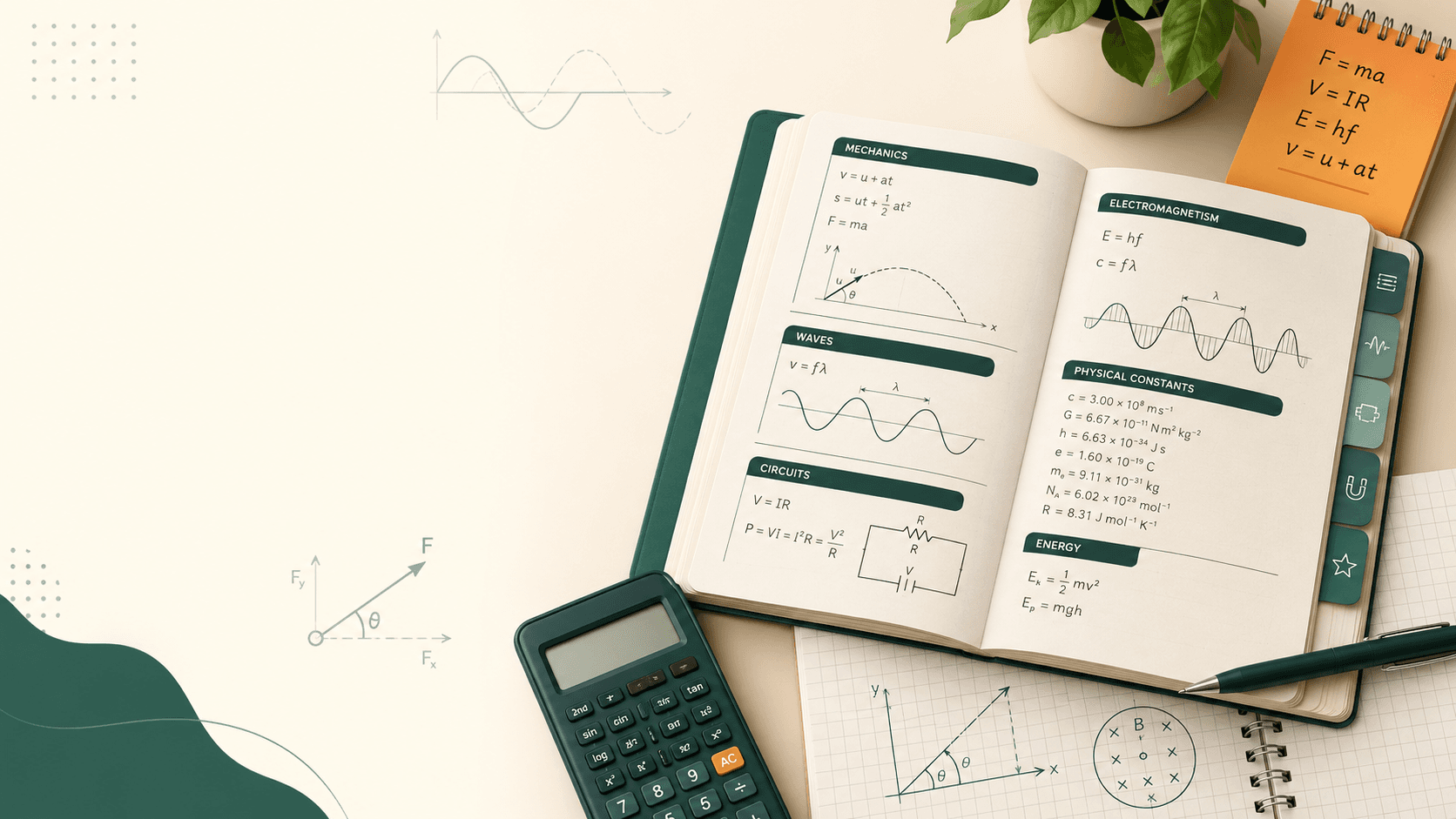
The IB Physics data booklet is one of the most useful resources you get in the exam, but it only helps if you know how to use it quickly. It contains constants, unit conversions, circuit symbols, and formulas for SL, HL, and option topics. For a searchable version, use the Baccalytics IB Physics data booklet alongside this guide.
This article explains what is in the booklet, how to revise with it, and how to avoid common mistakes when applying formulas under exam conditions.
What is the IB Physics data booklet?
The IB Physics data booklet is a reference document used in IB Physics assessments. Instead of memorising every equation and constant, students are expected to understand when and how to apply the information provided. That means the booklet is not a shortcut around understanding physics. It is a tool for solving problems efficiently.
For SL and HL students, the most important sections include metric multipliers, unit conversions, fundamental constants, electrical circuit symbols, and topic-based formulas. The Baccalytics version also organises the formulas by syllabus area, making it easier to jump from a topic you are revising to the equations you need.
What is included in the IB Physics data booklet?
A good revision workflow starts with knowing what the booklet can and cannot give you. The main sections are:
- Metric (SI) multipliers, such as kilo, milli, micro, and nano.
- Unit conversions commonly needed in calculations.
- Fundamental constants, including values used in mechanics, electricity, waves, and nuclear physics.
- Electrical circuit symbols for interpreting circuit diagrams.
- Formula sections for SL, HL, and option topics.
What it does not include is just as important: it does not tell you which equation to choose, how to interpret a graph, how to set up a multi-step calculation, or how to explain a physical relationship in words. Those are the skills that separate formula lookup from exam performance.
How to use the IB Physics data booklet effectively
1. Learn the topic structure first
Before you practise past paper questions, make sure you know which formulas belong to each topic. For example, motion, forces, work and energy, momentum, thermal physics, waves, electric fields, circuits, circular motion, gravitation, radioactivity, and energy production all have their own equation patterns. HL students also need to be comfortable with additional sections such as simple harmonic motion, fields, electromagnetic induction, capacitance, and nuclear physics.
2. Practise identifying symbols before substituting numbers
Many IB Physics mistakes happen because students recognise the formula but misunderstand the variables. For example, a symbol may represent force in one context, field strength in another, or a distance that must be measured from a specific point. When revising, cover the explanation beside the equation and test whether you can define every symbol before using it.
3. Check units before and after every calculation
The data booklet helps with units and constants, but you still need to convert values correctly. Pay attention to prefixes like cm, mm, kJ, mA, and microseconds. A correct formula with an unconverted unit can still lead to a wrong answer. Build the habit of writing SI units before substitution, especially in mechanics, electricity, thermal physics, and waves.
4. Use it actively during revision, not only during exams
Do not wait until exam day to open the booklet. When you revise a topic, keep the IB Physics data booklet open and practise finding formulas quickly. The goal is to reduce lookup time so more of your exam energy goes into reasoning, graph interpretation, and explanation.
IB Physics data booklet for SL vs HL students
SL students should focus first on the core topics: measurement and uncertainties, mechanics, thermal physics, waves, electricity and magnetism, circular motion, gravitation, atomic and nuclear physics, and energy. For SL revision, the booklet is most useful when paired with topic-by-topic practice questions.
HL students need the same foundation, but the booklet becomes even more important because the additional higher level formulas are denser and more interconnected. Fields, electromagnetic induction, capacitance, simple harmonic motion, diffraction, interference, and nuclear physics often require choosing between similar-looking relationships. HL revision should include formula selection practice, not only calculation drills.
Exam tips for using the IB Physics formula booklet
- Read the question command term first so you know whether you need a calculation, explanation, comparison, or evaluation.
- Underline the quantities given in the question before choosing a formula.
- Convert units before substitution, not after the final answer.
- If two formulas look possible, check which variables are actually known and which assumption the question allows.
- For explain questions, use the formula to support the reasoning, but do not replace the explanation with algebra.
Common mistakes students make with the data booklet
The biggest mistake is treating the booklet as if it contains the answer. It contains relationships, but the question still tests your understanding of conditions, assumptions, units, and context. Students also lose marks by using the wrong version of a formula, forgetting vector direction, mixing up radius and diameter, or giving answers with unrealistic magnitudes.
Another common issue is poor navigation. If you need a long time to find a formula, you lose time for the actual problem. This is why searchable topic organisation is useful during revision: it builds familiarity with where formulas sit and how topics connect.
A simple revision plan using the IB Physics data booklet
A practical weekly routine is to choose one topic, review the formulas in the booklet, define each symbol, complete several exam-style questions, and then write down which formulas you confused or forgot to use. Repeat this process topic by topic rather than trying to memorise the booklet in one sitting.
For example, if you are revising electricity, start with current, potential difference, resistance, power, internal resistance, and circuit symbols. Then move into exam questions where you must combine relationships across circuits and energy transfer. The booklet gives you the reference point; the practice teaches you when to use it.
Use the searchable IB Physics data booklet
If you want a faster way to revise formulas, constants, and topic sections, open the Baccalytics IB Physics data booklet. It is organised for quick lookup across SL, HL, and option topics, so you can move from formula reference to targeted practice more efficiently.
FAQ: IB Physics data booklet
Do I need to memorise the IB Physics data booklet?
You do not need to memorise every equation, but you should know what each formula means and when to use it. In exams, speed and understanding matter more than memorising the page layout.
Is the data booklet enough for IB Physics revision?
No. The data booklet is a reference tool. You still need syllabus understanding, worked examples, past paper practice, and feedback on mistakes.
How should HL students use the formula booklet differently?
HL students should spend extra time comparing similar formulas across fields, waves, capacitance, electromagnetic induction, and nuclear physics. Many HL questions require combining several relationships rather than applying one equation directly.