
IB Chemistry Data Booklet: How to Use It for SL and HL
Jamal Lewis
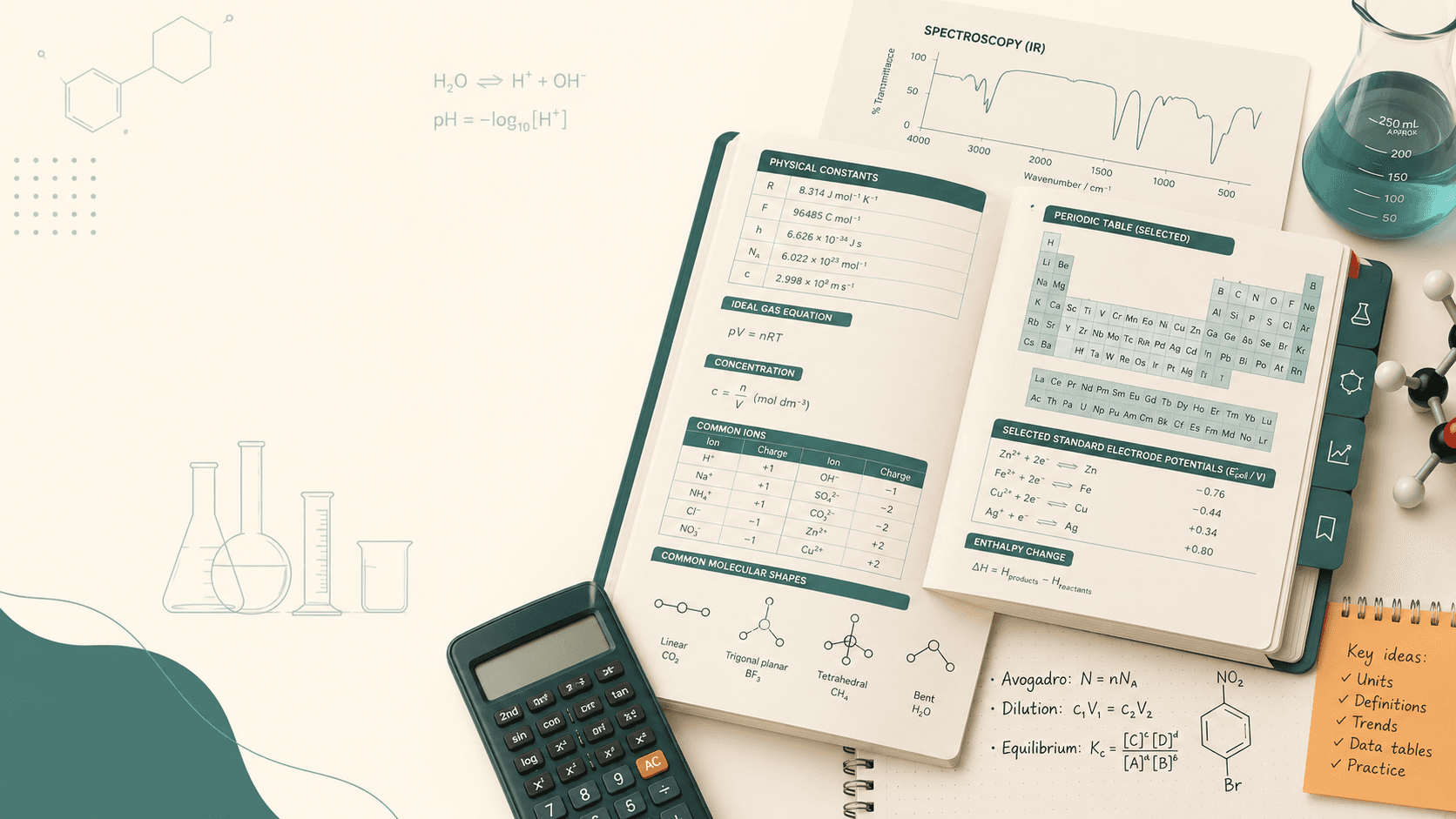
The IB Chemistry data booklet is one of the most important resources for SL and HL students. It brings together equations, constants, periodic data, bonding values, thermodynamic information, spectroscopy references, and lab uncertainty rules. For a searchable version, use the Baccalytics IB Chemistry data booklet alongside this guide.
This article explains what the booklet includes, how to revise with it, and how to turn data lookup into better exam performance instead of treating it as a last-minute reference sheet.
What is the IB Chemistry data booklet?
The IB Chemistry data booklet is a reference document used in IB Chemistry assessments. It gives students access to key data so they can focus on applying chemical ideas, interpreting information, and solving problems. The booklet is not a replacement for understanding chemistry. It is a tool that helps you work faster and more accurately when you already know what to look for.
For SL and HL revision, the most useful sections include relevant equations, physical constants, SI multipliers, unit conversions, the periodic table, bond enthalpies, thermodynamic data, acid-base indicators, standard reduction potentials, infrared data, 1H NMR data, mass spectral fragments, and uncertainty rules.
What is included in the IB Chemistry data booklet?
A strong revision plan starts with knowing which section of the booklet supports each type of question. The main areas include:
- Equations, constants, SI multipliers, unit conversions, and standard conditions for calculation questions.
- Element names, the periodic table, melting and boiling points, ionization energy, electron affinity, electronegativity, and atomic or ionic radii.
- Bond lengths, bond enthalpies, lattice enthalpies, and bonding diagrams for structure and bonding questions.
- Thermodynamic data and enthalpies of combustion for energetics problems.
- Acid-base indicators, standard reduction potentials, infrared data, 1H NMR data, and mass spectral fragments for analysis and identification questions.
What the booklet does not do is choose the method for you. It will not tell you whether a question needs Hess's law, oxidation state reasoning, equilibrium logic, redox analysis, or spectroscopy interpretation. That decision still depends on your understanding of the syllabus and the wording of the question.
How to use the IB Chemistry data booklet effectively
1. Link each section to the question type
Do not revise the booklet as one long list. Connect each section to the problems where it appears. Equations and constants support calculations, periodic data supports trends, bond enthalpies support energetics, reduction potentials support electrochemistry, and spectroscopy tables support compound identification.
2. Check units before substituting values
Many chemistry calculation errors come from using the right equation with the wrong units. Watch for dm3 versus cm3, kJ versus J, mol dm-3, temperature in kelvin, and pressure units. The booklet gives useful reference values, but you still need to convert quantities before using them.
3. Practise interpreting data, not just finding it
The exam rarely rewards simple lookup on its own. If you use bond enthalpies, you may need to compare energy changes. If you use reduction potentials, you may need to predict feasibility. If you use IR or 1H NMR data, you need to connect peaks to structures. Each lookup should lead to a chemical conclusion.
4. Use it during practice, not only during the exam
Keep the IB Chemistry data booklet open while doing topic practice. The goal is to become familiar with where information sits so that exam-time lookup feels automatic rather than distracting.
IB Chemistry data booklet for SL vs HL students
SL students should focus on core uses: equations, constants, periodic data, bonding values, energetics data, acid-base indicators, electrochemical values, spectroscopy tables, and uncertainty rules. The booklet is especially helpful when revising calculation-heavy topics and data-based questions.
HL students need the same foundation, but should spend extra time on topics where data must be combined across sections. Energetics, equilibrium, acids and bases, redox, organic analysis, and spectroscopy often require more than one lookup. HL revision should include multi-step questions where the booklet supports reasoning rather than replacing it.
Exam tips for using the IB Chemistry data booklet
- Read the question command term before searching for data, so you know whether to calculate, explain, compare, or evaluate.
- Write the units beside every value you take from the booklet.
- For energetics questions, check whether values are per mole, per bond, or per reaction as written.
- For spectroscopy questions, combine multiple pieces of evidence instead of relying on one peak or fragment.
- For electrochemistry, pay attention to direction, oxidation versus reduction, and whether the question asks for feasibility or cell potential.
Common mistakes students make with the data booklet
A common mistake is opening the booklet only after getting stuck. It is better to use it deliberately: identify the topic, choose the relevant section, check the units, then apply the data to the chemistry. Students also lose marks by copying values without considering signs, states, standard conditions, significant figures, or whether the reaction equation matches the data being used.
Another frequent issue is treating tables as isolated facts. Periodic trends, bond enthalpies, reduction potentials, and spectroscopy values all need interpretation. The mark often comes from the explanation that follows the lookup.
A simple revision plan using the IB Chemistry data booklet
Choose one chemistry topic, open the relevant booklet section, list the data or equations you expect to use, then complete exam-style questions. After marking, write down whether your mistake came from choosing the wrong data, using the wrong units, misunderstanding the chemistry, or not explaining the conclusion clearly.
For example, when revising energetics, practise with bond enthalpies, thermodynamic data, and enthalpies of combustion. When revising analysis, practise combining IR data, 1H NMR data, mass spectral fragments, and chemical reasoning. This turns the booklet into an active revision tool rather than a passive reference.
Use the searchable IB Chemistry data booklet
If you want a faster way to find equations, constants, periodic data, spectroscopy tables, and uncertainty rules, open the Baccalytics IB Chemistry data booklet. It is organised for quick lookup across foundations, elements, bonding, energetics, electrochemistry, acids and bases, spectroscopy, and lab skills.
FAQ: IB Chemistry data booklet
Do I need to memorise the IB Chemistry data booklet?
You do not need to memorise every value or table, but you should know what the main sections contain and how to use them. The faster you can find and interpret the right data, the more time you have for reasoning and explanation.
Is the data booklet enough for IB Chemistry revision?
No. The data booklet is a reference tool. You still need to understand chemical concepts, practise exam-style questions, and learn how to explain your reasoning clearly.
How should I use the data booklet for spectroscopy questions?
Use spectroscopy data as evidence, not as a single-answer lookup. Combine IR, 1H NMR, mass spectrum fragments, molecular formula information, and chemical context before deciding on a structure.
What is the best way to revise with the IB Chemistry data booklet?
Use it topic by topic. For each topic, identify the relevant section, practise questions that require that data, and review whether your errors came from lookup, units, interpretation, or explanation.